TLDR:
Reply with a weight gain build/mechanic idea you think would be fun for a turn based game!
So I recently discovered Slay the Spire and absolutely love it. I had heard it was good but I had always avoided it because of the art style (silly reason i know). But mann is it reaalllyy good. Its all I thought aboutand played for a week. But during one run I had an earth shattering idea: what if slay the spire, but fat!?!?
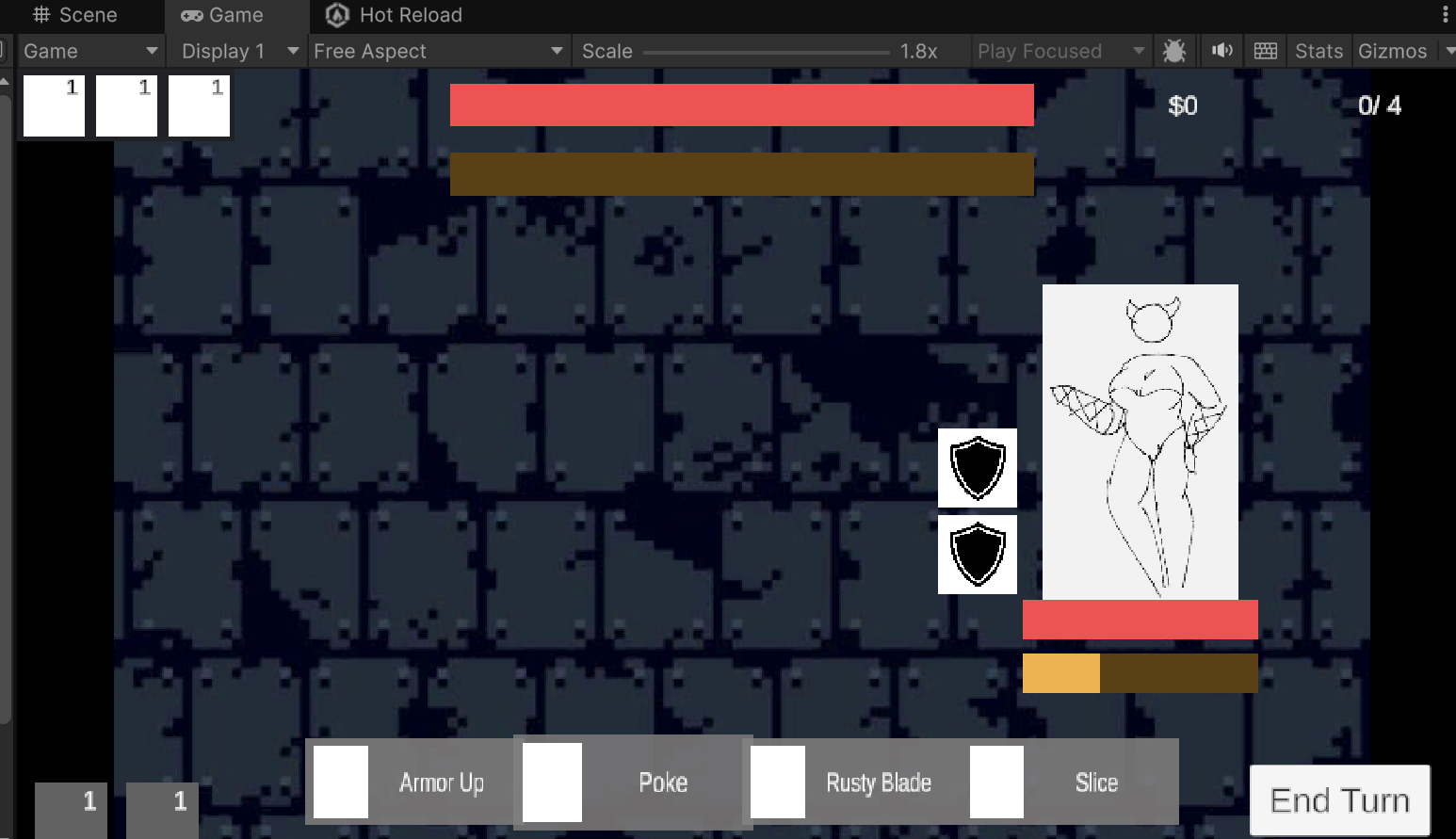
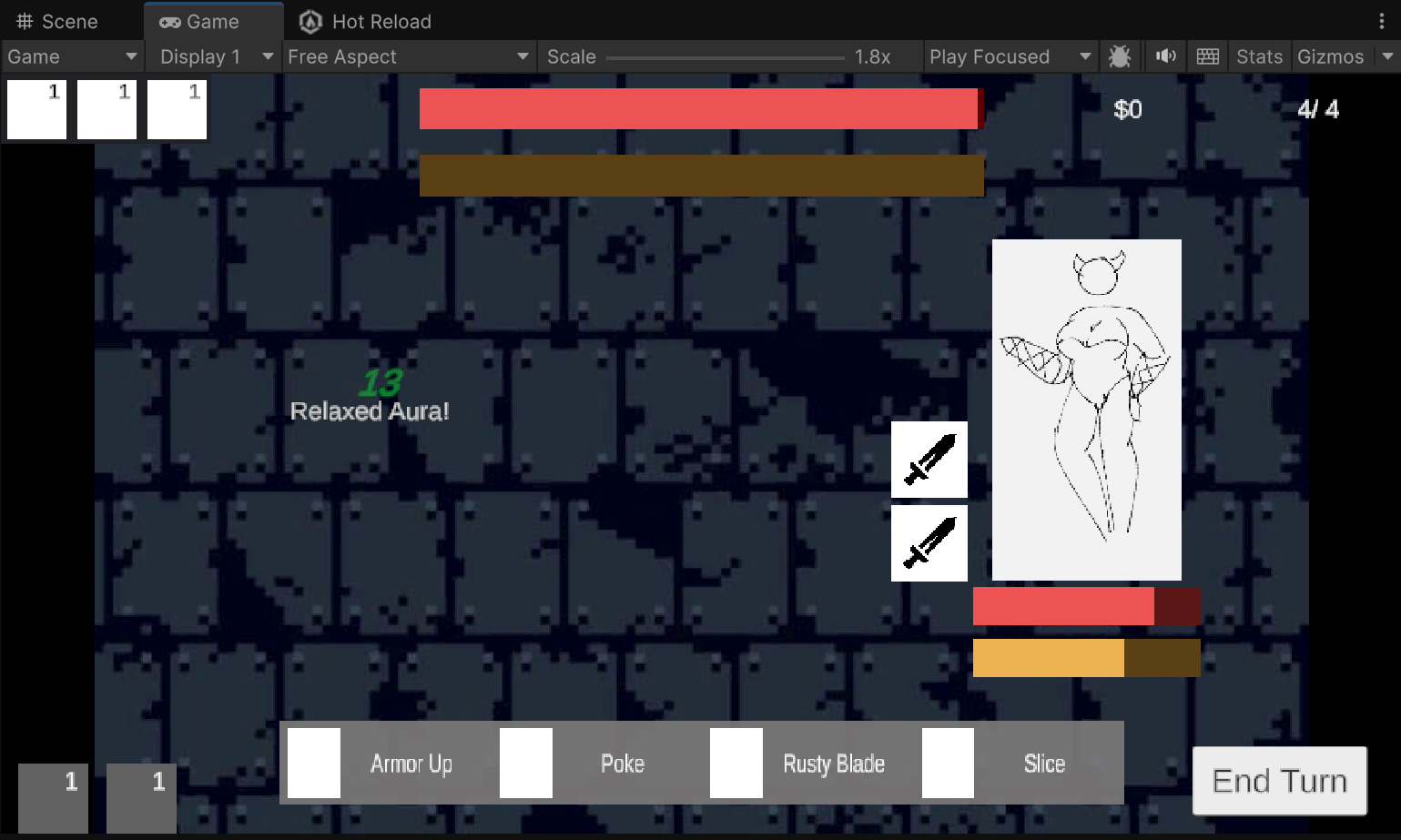
And so I embarked on a journey to make such a game come true. It took a lot of coffee, but I’ve finally gotten a combat system up to a point where I feel comfortable adding some weight gain mechanics without the risk of rewrites.
But now im pulling a blank. Maybe its my indecisiveness, maybe its slight burn out, but I’m just not getting any sparks right now. More precisely, I’m having trouble reconciling how to make weight gain builds that are balanced, and fun, while also being “easy” to understand.
And so I come before you all and ask: What WG Builds/Mechanics would you add to a dungeon crawler?
I should note, btw, that although this project is a roguelite game inspired by StS, it is not a deckbuilder, so no drawing, shuffling, or discard piles.
Fullness: Think of it like a stagger bar. When full, the enemy becomes too stuffed to fight and is stunned for one turn. Resets to 0 afterwards.
Each enemy has x “fullness stages”
Fill them up x times and win
Visual changes will follow, of course : p
There will also be an exploration aspect, but thats still being worked on.
Combat
1v1 turn-based combat
Stamina system: refreshed each turn, use it or lose it
Moves: pick from a predefined list, think more rpg or Pokémon
You’ll eventually be able to add / remove new moves as you progress
Persistent stats (per run): currently just maxHealth and maxFullness
Persistent items (per run): think relics from Slay the Spire
Buffs and debuffs are also supported
BTW I wouldn’t worry about any of the technical stuff, as the main point of this post is just to collect cool ideas. Feel free to go crazy with the concepts!
I could suggest one idea: any healing that should restore more than maximum health (that is, with the remainder) goes into filling, this mechanic should essentially extend to both (although of course the decision is up to you), this is a kind of healing control, you can heal the enemy in this way to make him more complete
This way you can create a weapon that heals when you attack (you can attack yourself to heal yourself.)
Let’s share notes! You’re doing more with them than me.
Classes
In a lot of Roguelite games, you select a class up-front (StS in the form of characters, Hades in the form of weapons, etc.). Consider the following classes / build paths for your game (I’ve based them on typical DnD classes for easy archetyping):
Paladin: Your character has a relationship with a god. One god could be the god of wrath, another could be the god of gluttony. The idea of this build is that you are strongly incentivized to defeat your opponent in a certain way or risk becoming an oathbreaker, invoking the fury of your patron deity. Or, maybe you just get extra cool stuff if you do things your deity likes.
If you don’t implement classes, this idea can still be implemented in the form of a covenant (think Dark Souls) which, when sworn to, offers you benefits at the cost of your fealty (cannot select another covenant without breaking the oath of the original).
Warlock: The same idea - fealty to a god - but this time you invoke the god’s wrath each time you don’t adhere to a randomly selected rule for the trial / combat encounter. Maybe they need you to use an item, or feed yourself, or defeat the opponent by feeding, etc. This would naturally incentivize more of a generalist playstyle rather than the specialized ones that roguelites often reward, so the reward for continued fealty to the god might be very good to enormous (depending on how many trials / encounters in a row you’ve shown loyalty).
Sorcerer: Also a magic-user, but with a twist - the sorcerer is constantly gaining weight and must shed it by using spells. The more weight you spend at once, the more powerful your attack. In a turn-based game, a lot can happen between turns, though; so, maybe becoming overfull in the context of your game isn’t as drastic for the sorcerer. Instead, maybe the sorcerer takes DoT based on how overfull they are. The idea is that their body is a barely controllable well of magic that is being stored - in the context of your game - maybe in their Fullness meter.
The trade-off with this class is that, although your spells are more powerful when you are fuller, you are at greater risk if you become stuffed between turns.
Soldier: This is more of a vanilla idea. The soldier is a warrior who can attune to their weapons, so unlock potential in weapons / relics you pick up during the game. Maybe each relic has a unique secondary effect that can be used / equipped if you are this character. Or, if you are planning on weapons being in the game, the soldier can unlock talents from weapons they have used over multiple trials / encounters in a roguelike style (pick from 3 upgrades).
This becomes a better integrated build if you were to implement something like rarities to said weapons. Overtime, instead of picking up new weapons, you are incentivized to sell them and upgrade your own to the next level of rarity to unlock more upgrades (i.e. Gunfire Reborn, Apocalypse Party).
Perhaps, if you are playing this class, you can sometimes encounter a Blacksmith who offers to give you a weapon of equal rarity & upgrades, but which is not the same weapon, at the cost of some currency. This way, if the player finds they don’t like the weapon they’ve upgraded, there is a costly but worthwhile alternative.
The way this integrates with weight gain might be that melee damage does more damage at higher Fullness, incentivizing risky play if the player chooses. Like I said… a little more vanilla.
Relics
I don’t have names for these, but that’s the fun part anyway!
Increase Max HP.
Increase Max Fullness.
Increase Max Stamina (if such a thing exists).
Metabolize some Fullness into HP every turn.
You do not get stunned after maxing your first Fullness stage each encounter.
Prevent your HP from going below 1 once; then, breaks.
Stamina increases at a faster rate each turn.
Immunity / Resistance to [negative status effect] (burn, freeze, venom…).
Enemies are inflicted with 1 [negative status effect] each turn (burn, freeze, venom…).
Increase damage of abilities that do [element] damage (fire, ice, poison…).
When inflicted by [negative status effect], gain [status effect] (attack up, defense up…).
Your ability in slot [#] becomes permanent and more powerful; then, relic breaks.
This could be more fun if you normally upgrade abilities during the game.
Presumably, your abilities are fixed to some sort of slot, so maybe which slot this relic impacts might be randomized.
Counterattack with your ability in slot [#] when defending.
Deal more HP damage to foes with high Fullness.
Each turn, you and your opponent gain [#] Fullness.
You deal more HP damage the higher your Fullness meter is.
Fullness inflicted on you is also inflicted on the enemy.
You can spend [#] Fullness stages to consume an enemy on their last Fullness stage.
This is amazing!! This is exactly the kind of design talk that I need to get my creative juices flowing
The classes are a great idea and something I already had my eye on. I had had the idea of allowing the player to choose a character before starting a run, but that was mostly going to be a cosmetic change (choosing between different body types). It’ll be infinitely more interesting if we pair this with a distinct gameplay identity, as you’ve outlined in your ideas for classes. The items are also solid, though the naming process will have to wait until after I decide what the setting is. I especially like the last item
Speaking of which, you have some really good thoughts on what makes a class shine. Have you worked on something like this before?
The overhealing mechanic (which can make you or your opponent more filled up) can be interesting, especially if XP is involved - you could stretch on a combat for longer, and farm more from one battle. I would argue that getting an enemy completely full should disable them from being able to do any physical attacks (or make it more likely that they’ll miss).
Another thing linked to either classes or items could be various status effects, and how they affect fighting (I’m borrowing a bit from “Dungeon of the Devourer” here).
Essentially, various status effects can be applied to enemies (instantly full, bloated, starved, etc.) which basically negates one of their stats while raising others (fullness limits their physical attacks, but could increase mana-based attacks, for example), so the player would have to be careful with what status effect they apply to an enemy. Conversely, various status effects can be applied to the player as well, forcing them to be adaptable to still be able to fight when afflicted.
There could be various items or weapons that apply these status effects, and/or, if the player chooses a specific class, that class’ specific toolset or tasks will enable them to apply certain effects.
If you use events the same way StS does, I think it’d be cool if some were pass/fail based off your character’s weight/fullness. Your character has to be lithe enough to fit through a door or heavy enough to trigger a pressure plate, or you can sacrifice some fullness to eat this ‘suspicious stew.’
On top of this, I also like the idea of combat moves that benefit from the same weight/fullness mechanic but also encourage a higher or lower value. Something along the lines of ‘attack x amount of times but attack 1 less time for every fullness stage,’ that way you can make more build diversity or classes that want to be at a higher or lower fullness/weight. Along the same lines, a character could be wearing a suit of armor that passively causes them to take less damage but they lose that perk if they grow too large to fit the armor.
Speaking of which, you have some really good thoughts on what makes a class shine. Have you worked on something like this before?
I’m flattered! I play lots of roguelikes / roguelites. I haven’t published anything, but I have prototyped quite a few game ideas for others and (mostly) for myself. Not unlike a lot of people here, I don’t have the time / commitment / [good excuse] see it to completion. I’m glad people like you do!
I especially like the last item
If you are a big fan of vore I’d recommend baking it into the mechanics, otherwise - as you know - you’ll have to wait for that item to randomly show up in rotations. But yeah I think if it’s more of a tangential interest having it be an item works well.
I can already see a “gainer” build on the horizon: focus on increasing your Fullness, playing risky, maybe trying to mitigate that risk with some sort of overfull mechanic / damage reduction / dodge chance. The “hurt me” builds in roguelites are always good fun! Looking forward to what you do with the game.
Another idea: if the enemy has a healer, or some other unit that gives a status boost to other enemies, you could implement items and spells that hijack those boosts, in case the boosted enemies are untouchable, or their boosted status prevents any meaningful damage to them.
For example, an enemy healer’s healing can be jacked up so much that they overheal enemy goons who only have physical attacks, causing them to become immobilized and useless.
Alternatively, you could hijack them in a way that gives them debuffs - an enemy healer can still heal, but their healing also causes breast expansion, meaning that an archer or other ranged-weapon using enemy they’re healing would have trouble hitting you, or it causes ass expansion, which makes DPS-type enemies more sluggish. Substitute expansion with bodyshape-specific weight gain, and you basically have a fine-tuned version of the overhealing-based heal hijack, maybe as a less costly to use upgrade.
One build idea I wanted to implement into a project of mine but couldn’t get working was weaponized wardrobe malfunctions, like outgrowing armour and buttons flying off and hitting people. A playstyle centering equipment as something always-needed and disposable where you want lots at once instead of just swapping to the better thing has always been an interesting idea to me
My take (which might not be helpful, since it’s a bit of a core gameplay loop and you sound like you’ve already got that, but maybe there’s something worth cannibalizing here) -
The Hero has a Calorie Meter that fills from exploratory opportunistic encounters (buying food from a vendor, risking the POISON status effect by eating that dead monster you stumbled on, etc etc) or specialized combat moves (BITE does less damage than SHANK but fills the meter a bit).
Topping out the Calorie Meter resets it to being two-thirds empty, but adds WEIGHT. Weight, in addition to cosmetic changes, adds Damage Reduction / Armor and is a multiplier in some combat moves. Affects some non-combat encounter options, too.
Most options reduce calories. The early game is easily breezed through using high-output, calorie demanding skills/moves, but gaining WEIGHT is a vital element of leveling. Past a certain point it makes sense, mechanically, for the player to be ‘trimming the fat’ out of their option deck by removing the moves that aren’t enhanced by the WEIGHT stat, and the thematic moveset is phrased / illustrated in a way that enhances the theme of becoming obese.
My super-secret ACTUAL take on a WG dungeon crawler is that...
… the player fights in a Blobber-style dungeon (First person, grid based movement, 4 member party, ala the old Bards Tale or Skullkeep games) using slimes (aka Blobs) who have stats and skills based on their “DNA”. Between delves the player has access to a minigame where they can use captured enemy materiel to build the “DNA Ring” for new slimes bit by bit, trying to get the sequences that they’ve discovered (through enemy corpse study and previous build attempts) allows for things like “Breathes fire” or “Immune to poison” crammed within a limited number of empty slots. The number of slots depends on the PC’s weight (they’re the breeding vessel). So they need to Blob-Up the PC to fit larger Blobs with more DNA slots inside themselves, which allows for higher stats and better special abilities for the fighty bits.
Fullness meter, everytime you eat/drink, your stomach gets full. Which can cause
bloated: causing the player slow movement in combat and overworld, but causing slow healing when damage, also your stomach bloats more and more in the overworld
Fullness: Unlike bloated, Fullness can slow the player to a standstill if they eat to much food, which can then cause them to fall into a food coma
And about to burst: overeating causes the player to expand like a fat balloon, and possibly may damage them until they die or drink a potion of fast digestion, which instantly makes your stomach empty, but you’re fatter.
–
Also I really love detailed customization for the player. Choices help as well
–
Also the more weight you gain, the more you slowly move, and struggle with doors
 I play lots of roguelikes / roguelites. I haven’t published anything, but I have prototyped quite a few game ideas for others and (mostly) for myself. Not unlike a lot of people here, I don’t have the time / commitment / [good excuse] see it to completion. I’m glad people like you do!