I wanted to ask what everyone on this site has been doing lately, and maybe share what projects they are working on - if any. Because I personally haven been spending the last few years working on a weight gain game, and while progress is slow, I think I am getting at least better at the whole “making a game” thing.
And I have heard a lot of things over the years, but lately talk about how there’s a lot less activity on here seems to be circulating. I really wanted to respond then, since I haven been working on something, but I usually think I don’t have anything ready to share, and if I don’t have something for people to play, then I shouldn’t say anything at all.
Any maybe other people are like this too, with projects in the works but not in any state to play, nevermind release them.
I personally really love this site, since it’s a place for developers to share their works and stories, and while I haven’t been very active at commenting or posting in a while, I really should just post this instead of having it only in my head. This is the reason for this tread. I want to at least share what I’ve been doing, even if it’s not at all ready for any sort of playing and probably won’t be for years yet, and maybe other people will want to share their stories too.
Who am I?
But first, a bit of background. I’ve found this site in 2019, and participated in the jam that year. You can’t download that entry and more (it wasn’t very good anyway), but I think some videos of it might have survived? My project files certainly didn’t. It was a top-down pixel art game made in Unreal Engine, but well, I had maybe a year of Unreal Engine experience and maybe two or three of coding in general (self thought at that), so bad is an understatement. The pixel art itself was also poorly done. But like with everything you do long enough, I’ve gotten better.
Then just a year later I’ve made a translation/mod of Feeder Fantasy by Fallboy. Without being able to understand Japanese. Just thinking about it is really embarrassing, and I really feel bad about some of the “additions” I made. Originally I just wanted to improve the machine-translation, move the dialogue so everything fits on screen and check the dictionary what each word means and adjust the dialogue based on that, but since I didn’t understand the language I may have taken a few (a lot) of creative liberties. And if I’m messing around with it, surely it wouldn’t be a bad idea to add some sprites, and while I’m doing that why not change some of the things I’m less comfortable translating and replace them, or add to this unfinished section …
Yeah, in hindsight maybe not the best idea. I have no idea what the developer though of this, but I personally feel bad. I know mods for games exist and thus did not think much about it, but just changing things in someone else’s game…
The year after that, I tried translating another game “A maid’s long vacation”. I think I got better at translating, but I still did not and do not properly know Japanese, so it’s still just a dictionary translation. (That is, using a dictionary to look up all the words and figure out what everything means that way)
Then came “Raising money in town”, another translation, this time with sprites-changes again, but instead of rudely changing things, I just added overworld-sprites for all weight changes while trying to stay really faithful to the game’s illustrations and descriptions. I think that worked well, and the developer for this game also seemed to like my sprites and used them for the Japanese version, so that is great.
I did try translating other games later as well, but I really wanted to fully learn and understand Japanese first, and that’s still going on, so I sort of just stopped with translations. It doesn’t help that while I started with Japanese in 2018, I haven’t had any formal classes or courses (there aren’t any around here, and I don’t think I would have had the time either), so it’s various different methods of self-study using textbooks. Well, at least currently (so seven years after I first started …) I’m better at learning a language to the point where I feel like making real progress. It’s still going to take a at least a year more until I’d call myself elementary school level, though. Oh well, progress is progress.
2022 was the next year I participated in the game yam, with another game in Unreal Engine. This one still has a working link too. Raiding Fairies was a 3D … something game? You can build houses to spawn fairies, and it has a really bad text-adventure component that gives you resources and makes the fairies fat. It … really wasn’t great. There effectively isn’t any fun gameplay present. Game-design wise I’d call it a failure. The building part is just placing pre-made houses, which fulfil their function at that point and are not needed any more, while the text-adventure/expedition section is too repetitive and just plainly unfun. This lead me to rethink my general project and start the current one (which has thus been in development for three years), but first, what have I been working on before that point anyway?
I’ve been wanting to make games since about 2018, so I’ve been learning programming since then. First with C++ and an SDK (which dramatically failed, obviously someone without any experience should probably start with something less ambitious, but), then Unity, first in 2D and 3D. The first project wasn’t very good (obviously), but it did contain self-made models, a map, enemies, trees, mushrooms and so on. Though since I still didn’t know much programming it was poorly made and ran badly, but oh well. Unity needed a subscription for eventual commercial use though and Unreal just announced not taking any money, so I switched to playing with Unreal again. (I can’t really call it developing since at this point I had less than a plan and was mostly experimenting. I guess Unreal’s marketing worked?)
That was in early 2019, so when I found Weight Gaming and heard about that first game jam, I joined, but I wrote about that already.
At this point I had some idea of what I wanted to do (and made my own editor for game-data in C# too, first for Windows-CMD then with Xamarin for Windows and Android), so I definitely got better at programming. I also got a job as a programmer apprentice. But while I had an idea, and some structure, proper game design experience I had not. Nor had I any experience with projects and consistency, so I flip-flopped between 2D and 3D depending on what kind of problem I experienced at the time, and didn’t make a lot of progress at actually making a playable game. Some of the ideas I had would work better in 3D though, so 2D doesn’t make sense, right? But 3D also has issues…
Then it was 2022 and time for the next game jam.
I learned several important lessons then. The first being: I do not enjoy working with a 3D workflow.
Compared to just drawing sprites, especially pixel art, 3D is less fun for me.
The next being: I really should think about a fun game design first, before anything else. So I tried that. I benched my current 3D project and started over, made a concept document, thought a lot about gameplay-loops, and started on a 2D pixel-art game in Unreal Engine.
I’m going to go into more detail in the next subsection (as if I haven’t written way too much in this preface already), but to say one thing first: Unreal Engine was maybe not the best choice for the kind of 2D pixel-art game I am working on. Ouch. Good thing I realised this after only three years…
What I’ve been working on
The initial idea (and that I’m starting like this really shows how good I am at planning and keeping to said plan, doesn’t it?) was to take the building and resource gathering aspect from “Raiding Fairies”, and flesh that out. Using proper well-defined characters, VN-style dialogue, a better expedition and task system in a turn-based style, putting in resource management with hunger, food and so on. From a gameplay perspective, you were supposed to send characters to do tasks in a UI, receive the rewards some turns later, get surprised with events in between, receive daily summaries, the whole management experience, plus a cooking minigame, with other minigames planned. I even managed to write an external Data-Editor in Kotlin (Compose) for Android, Windows and Linux so that I could use a data-driven approach for game objects.
Then I tried playing what I made and … ouch. I did not enjoy it at all. Seems like, while I did learn something, I failed to see the fundamental problems “Raiding Fairies” had and thus just expanded on them. And I hadn’t even implemented the building system yet. A bit over a year of work and still nothing to show for it, yay…
Well, back to the drawing board as it were. At least not everything would need to be changed. I asked myself, what kind of games would be fun? What about this wasn’t? Because fundamentally this is a hobby project, a game I’m making because I enjoy programming and drawing and designing, and even though I might not have much time to work on this, especially with my job also being programming and thus leaving me too drained to program privately on most days, I still want to make a game I will have fun playing.
So I switched from turn-based to realtime and from top-down observer to directly controlling the the main character in everything. No expeditions and boring UI, the plan is now to tell your characters what to do and have them really do it. Well, it’s a work in progress. The switch to realtime worked, you can now pick overworld items up properly, respawns and object-placement works, and so on. Still, reworking the code for nearly all systems (and it’s mainly systems since I wanted to wait with concrete content like dialogue, sprites and events until all base systems were working) too a while. That is done though, so while the system for telling your characters what to do, as well as the building system still need to be added, I am getting somewhere.
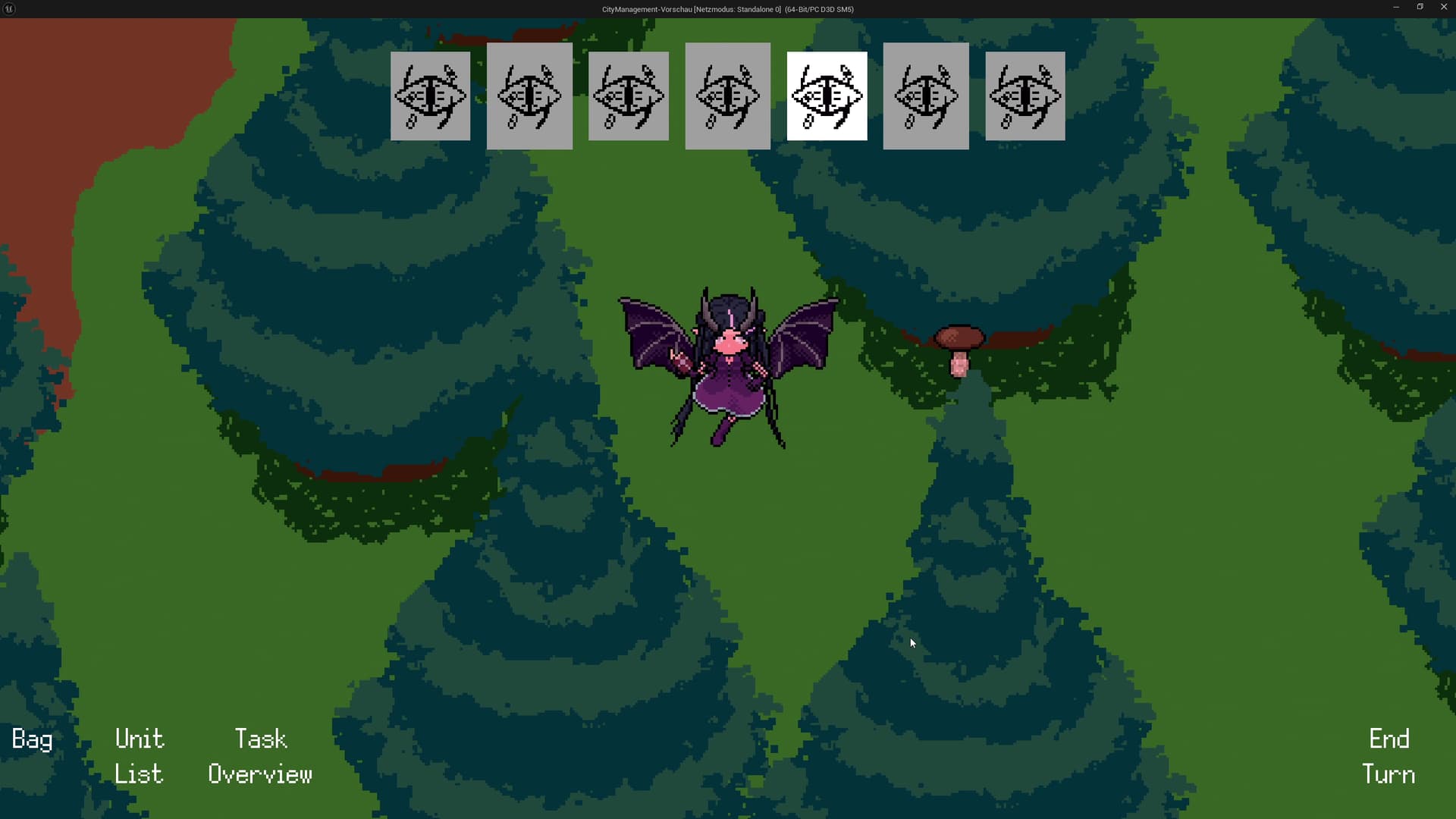
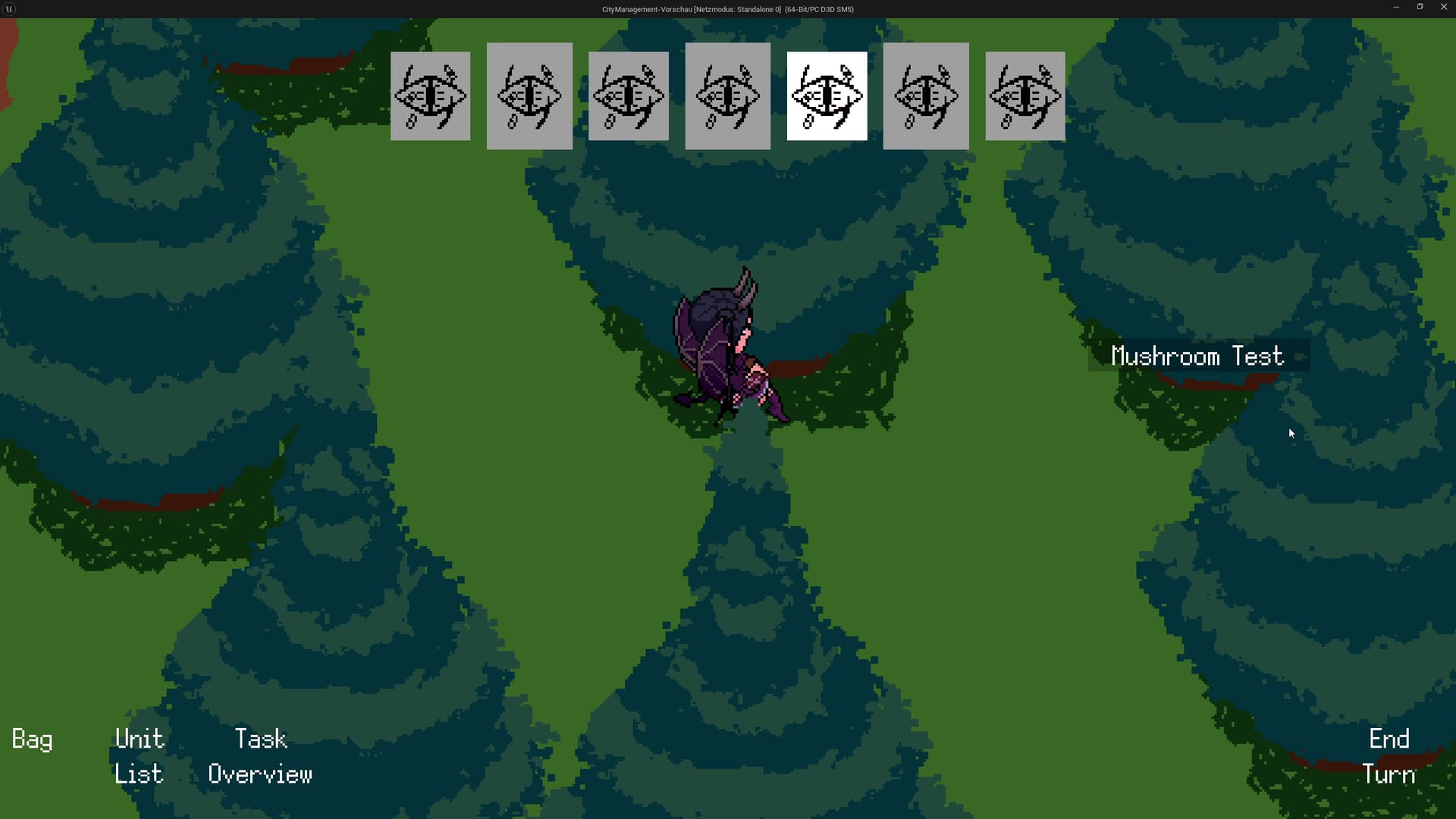
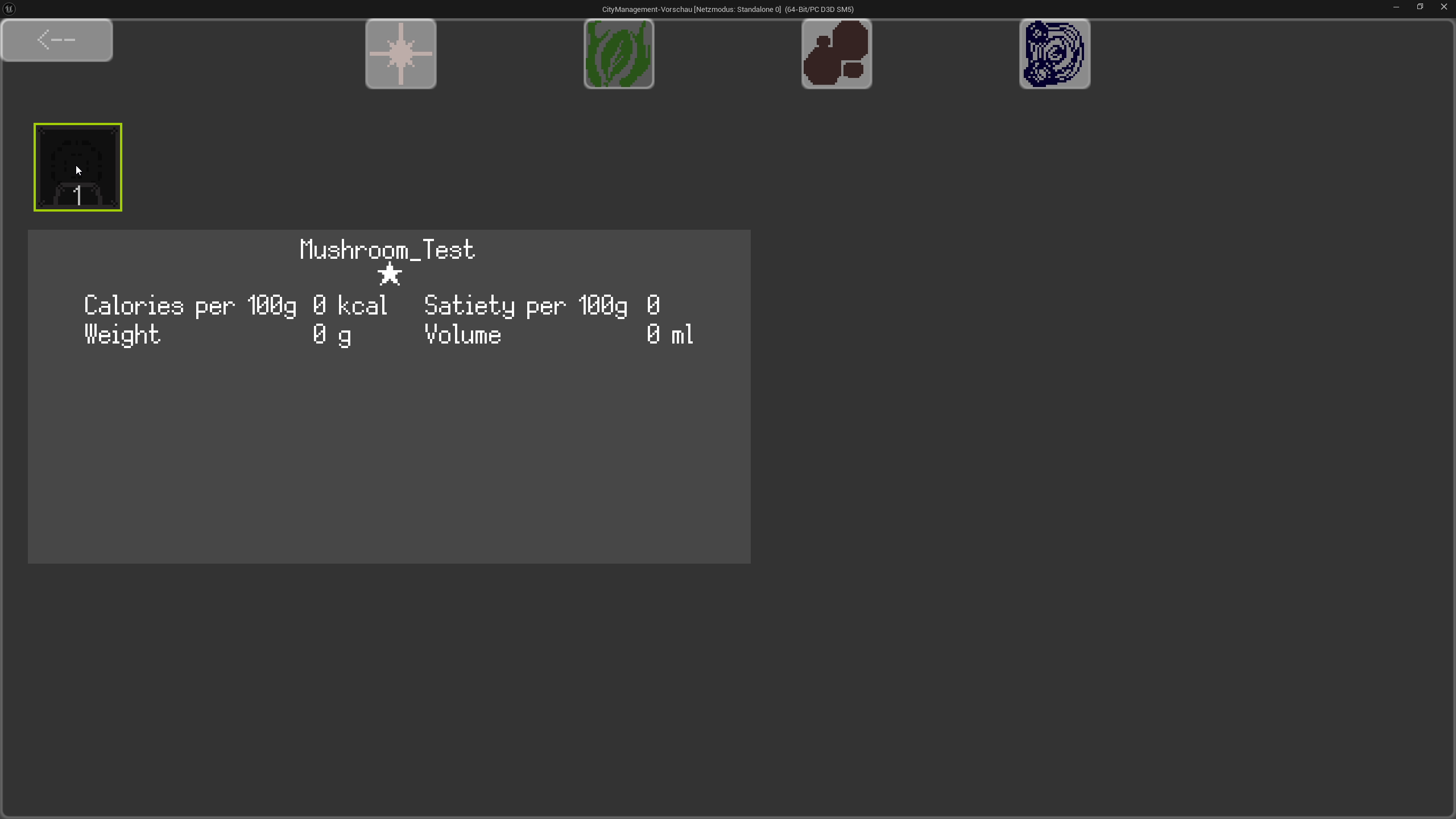
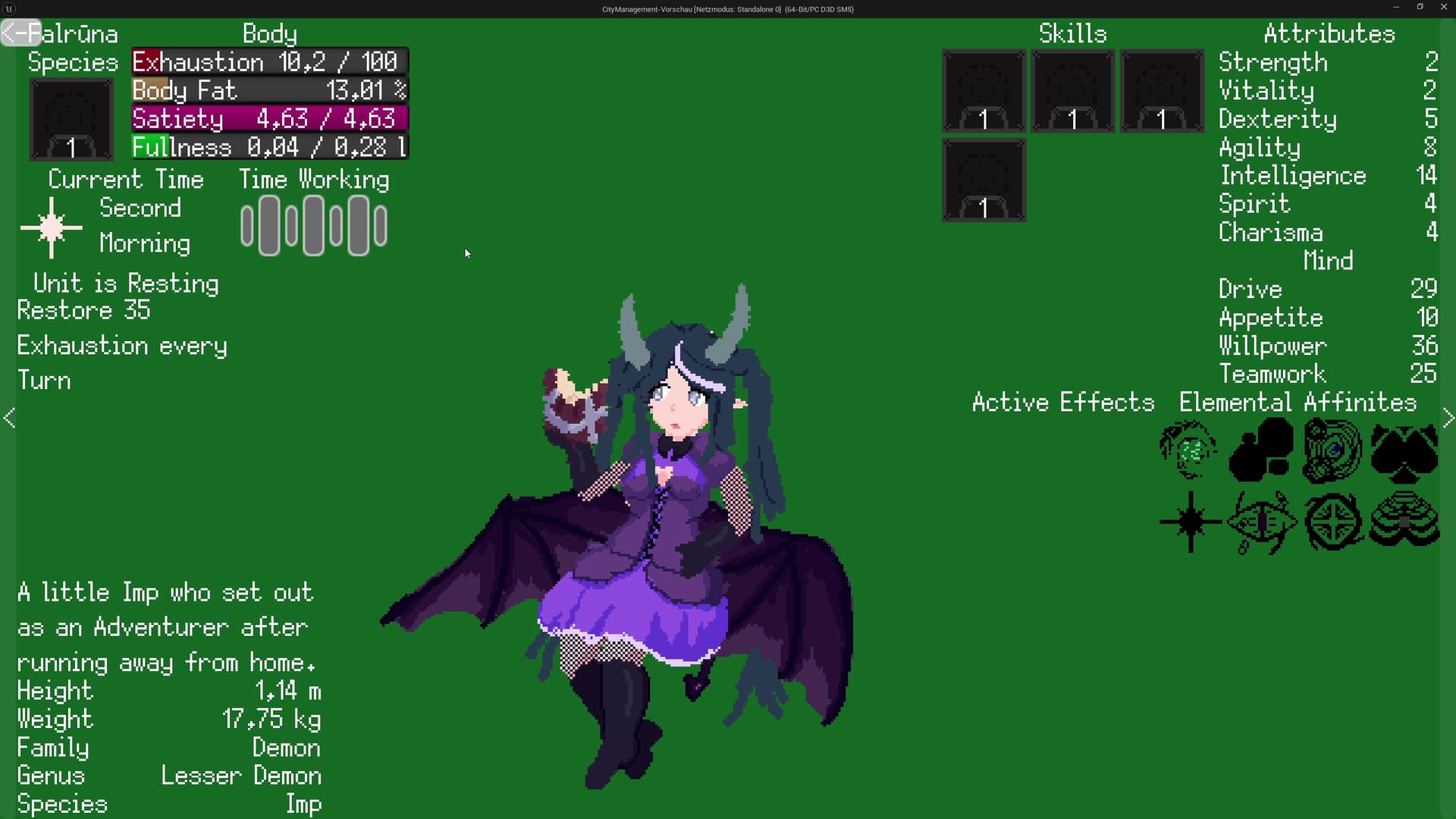
I did have a lot of trouble with the cooking minigame though. The first iteration was missing the “game” aspect (which seems to be a theme, though literally just making a Gnatt Chart as a supposed mini-“game” is a new low), while the second took to long to play for something you likely had to do quite often and encouraged repetition instead of experimentation. The third attempt seems to work better, even if the initial design was also taking too long. Well, it’s just roasting food over a campfire for now, so this minigame reflects that in that you take a skewer of food and must hold at the right distance from the fire, so that it evenly roasts (without burning or charring it), while also managing the fire itself. It’s still a work in progress. I think the first-person view would work nice for this at least.
Really low quality gif of the in-progress cooking, a lot needs to be redone or adjusted, like having the hand follow or adjusting the size of everything to fit correctly (I made a mistake with the test scene, so everything is to big) This should at least illustrate the idea.
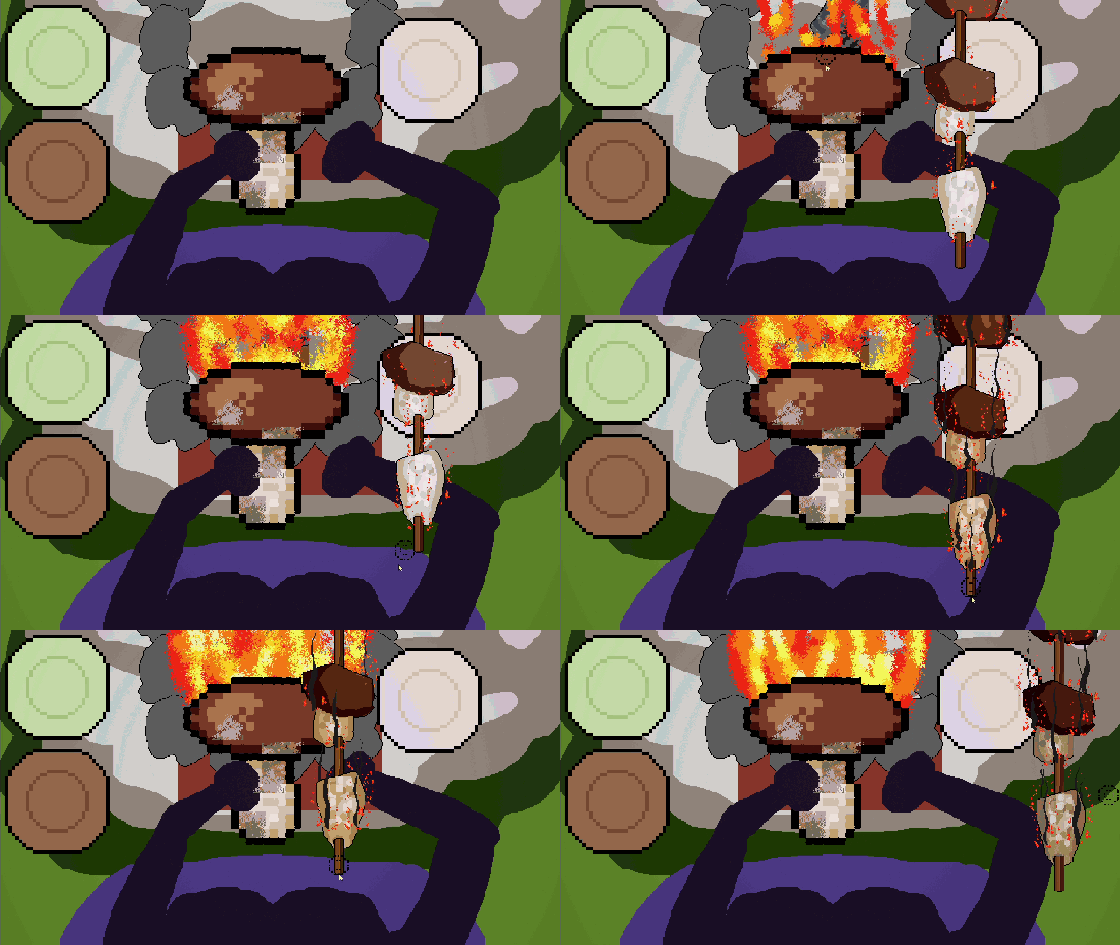
I think it looks decent already, right? But like I already hinted way too many words ago, it did take me until now to realise some fundamental problems with using Unreal Engine for this…
Mainly, Unreal Engine is a 3D engine. That means, the scene, the way graphics are rendered, the way objects are arranged, and so on, all are designed for 3D. I naively thought, since it had 2D support it would be fine to use.
What a fool I’ve been.
It’s nearly impossible to display anything pixel-perfect. Each pixel gets stretched when the resolution isn’t an even multiple of a certain base, which is sadly the case when trying to use consistent scaling for different screen resolutions. So either I accept non-square pixels or that my game looks horrible on most screens (it also messes with planning the sprite-sizes and full-screen CGs. Joy.) UI-elements are misaligned in regards to the world’s pixels, nevermind the text even with a pixel-art font.
In addition to that, trying to make sure characters can go in front of or behind objects is a nightmare for either visuals or performance. Slightly tilting sprites allows for a performant variant, but bigger sprites break that completely. It also messes with the pixel display, even at 0.5° tilt. (That was the solution I used in my 2019 game jam game). Meanwhile, dynamically adjusting the position of all objects on screen depending on their Y-Coordinate costs quite a lot of performance.
In general, performance is a bit of an issue. I know I’m not the best programmer, even without any code running the engine sometimes falls under 60 fps with just a few sprites on screen. With the moving algorithm that can sometimes end up even lower. Ouch. I might be able to optimise things a bit more here, but without having even added some of the heavier logic yet…
So in all, Unreal might not have been the best choice, though the pixel display issues are by far the ones that annoy me the most.
Future progress
I’d love to be able to say I’m going to have something playable by INSERT DATE HERE, but that’s not realistic. But what I can say is what I’m planning on doing now, so that is at least something. (Though considering those plans, well…)
I’m going to switch away from Unreal Engine. And make my own. And I’m aware that this will be really difficult and likely take a stupid amount of time, but it would really make me a better programmer, it sounds like fun, and none of the currently available engines are really ones that I want to use. So I’m going to be busy with that instead of working on directly game-related things, but at least the result should hopefully be good? Since I’ve got nearly the entire December as vacation time, it’s an ideal time to start. The goal is an optimized engine for 2D Pixel Art using OpenGL in C++ for both Windows and Linux (any maybe Android, though not as a priority)
It will just take time.
So what has everyone else been working on? What development stories do you have to share, even if it’s something that is not yet ready? I’d love to read about that.


